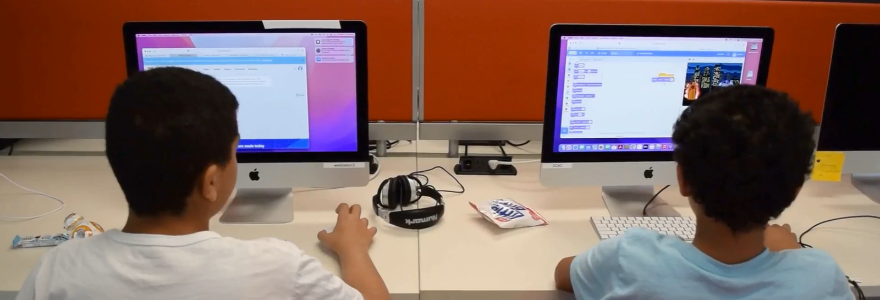
Two children participate in the Boys and Girls Club Ready. Set. Code. camp.

Two children participate in the Boys and Girls Club Ready. Set. Code. camp.
A Faculty of Education social action research project from professors Immaculate Namukasa, Anton Puvirajah, and Paul Tarc – STEAM maker education in resource-challenged communities in London, Ontario – has culminated in the launch of new community-based STEM learning opportunities for equity-deserving K-12 students.
The study, which was completed in collaboration with Western social science professor Godwin Arku, and King’s politics and international relations professor Thomas Tieku, analyzed the strengths, benefits and constraints of informal STEM programs aimed at K-12 students from low-income communities.
The analysis of existing community-based STEM education programs revealed that these supports did not fully meet the needs of children and youth in the target demographic. To help address this gap, the researchers, along with their graduate research assistants, worked with community-based program coordinators to develop and pilot new solutions including STEM resources, camps and programs.
Through this project, the Faculty of Education provided funding for STEAM outreach opportunities including for the new Obuntu Heritage Kids STEM and Culture Camp and the existing homework outreach club led by the Ghanaian Association of London & Middlesex (GALM). Western Education students provided assistantship, internship and volunteer support in roles such as facilitators for these and other community-based STEAM programs. The professors, a post-doctoral fellow, Nedra Peter, and the directors of hosting community organizations provided oversight.
“This social action project created mutually beneficial learning opportunities for school children and youth, and for Western’s students, who learned through research assistantship, field experience, and volunteer service opportunities,” said Namukasa.
“We have been pleased to hear positive feedback from the communities and families who benefited from the interactions, lessons and resources we supported. We are proud to help children and youth reach their fullest potential through gaining a solid foundation in STEAM.”
During the study, the researchers developed strong relationships with many local community organizations, sparking several other STEAM programs that continue today. Many of them are still supported by the work of Western Education graduate students.
The Obuntu Heritage Kids STEM and Culture Camp was an immersive day-long experience where children explored African culture and innovation through music, storytelling, games, STEM workshops and performance. The inaugural camp funded by Western Education was held in May 2024. With funding from Western Engineering, the support of Western Education, Western’s Office of Equity, Diversity and Inclusion, and Dr. Margaret Mutumba of the Africa Institute and Frugal Biomedical Innovations, the camp was held again on the university’s campus in 2025.
At the 2025 camp, over 60 children had the opportunity to explore STEM concepts including artificial intelligence, media literacy and technology design while enjoying sports activities and Ugandan crafts, music, dance and storytelling. Parents and guardians who formed the audience when the children performed a showcase of their learning provided enthusiastic feedback including: “That was amazing. It is refreshing to see so many cultures in one place. Can we have it more than once a year?”
The GALM STEAM Kitchen, another project seed funded through the study, also later received support from Nuamah Agyei, MA ’26, in the field of critical policy, equity and leadership studies, who acted as a learning activity developer, facilitator and instructor. This project, which offered sessions from 2025 to 2026, was created to help children of Ghanaian Heritage living in London learn about science, technology, art and mathematics in the context of intergenerational learning through cooking.
“Some families in our community believe that issues of science and technology are something that happen in the lab or in the classroom. It kind of feels far away from them,” said Agyei.
“We wanted to demystify that notion that science and technology is an everyday thing. So, we decided to use a simple way of cooking African or Canadian cuisine, to teach science concepts like osmosis, diffusion, chemical reaction and heat transfer.”
Though Agyei decided to volunteer for the program independently to give back to his community, the opportunity was well aligned to his master’s program where his research focused on gender equity in educational policy, specifically how policy and donors influence girls’ education in Ghana.
“The STEAM Kitchen was an important opportunity to allow both boys and girls to learn these concepts. It helped to erode gendered notions about being in the kitchen,” said Agyei.
“I really enjoyed the process of making these educational concepts very meaningful and tangible. Once education becomes practical, I think students have fun while learning real life skills and STEAM concepts. You could see the joy and happiness on their faces, so I was really proud of that.”
While many students who supported the original project activities with community partners have now graduated, the new programs that have emerged continue to benefit students at Western. Antonia Yip, PhD candidate in curriculum studies, specializing in literacies in school mathematics, has been supporting the Boys and Girls Club Ready. Set. Code. camps since 2024.
Ready. Set. Code. helps young learners explore topics including mathematics, coding, problem solving, storytelling, and using AI to design prototypes focused on solving real life problems. Previously mentored by Dr. Marja Bertrand, Yip has acted as both a learning activities designer and facilitator for the camp. She also conducted field research on the efficacy of the program as part of her research assistantship for Professor Namukasa. For Yip, this community engaged learning offered invaluable insights connected to her research.
“I focus on curriculum studies, so this was an important opportunity for me to reflect on how theories in curriculum can be used in practice. It’s about responding to students needs and making modifications based on my experience and students’ knowledge,” said Yip.
“As a professional educator, I enjoyed the opportunity to facilitate students’ learning in an informal educational setting where they have space to create and collaborate. It was a meaningful opportunity for me to be able to witness them helping each other and to guide them through the learning process.”