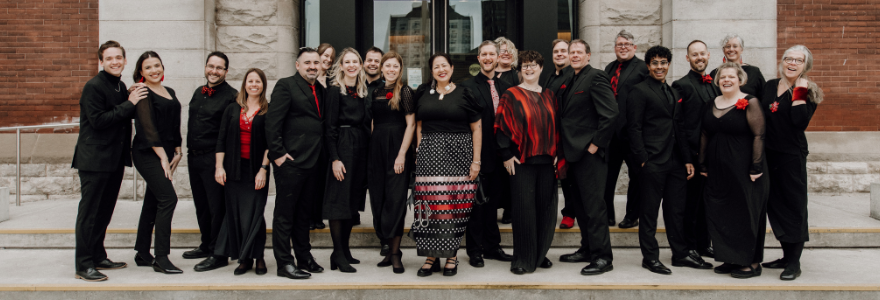
The Canadian Chamber Choir and Sherryl Sewepagaham.

The Canadian Chamber Choir and Sherryl Sewepagaham.
Professor Danielle Sirek, PhD, has been nominated alongside her peers from the Canadian Chamber Choir (CCC), and Cree-Dene composer and vocalist Sherryl Sewepagaham, for Classical Album of the Year (Large Ensemble) at the 2026 JUNO Awards for Where Waters Meet: Sherryl Sewepagaham + Canadian Chamber Choir.
The CCC is a 21-voice professional ensemble comprised of singers from across the country, including several faculty and alumni from the Faculties of Music and Education at Western University. Sirek, arts coordinator and professor of arts education at the Faculty of Education, has been a soprano in the CCC since 2016 and has served in various other capacities, from board director to Indigenous collaborations lead.

The album recording features the CCC-commissioned multi-movement work Where Waters Meet by Yellowknife-based composer Carmen Braden, which explores water from both non-Indigenous and Indigenous perspectives. The piece includes texts by the composer, by the singers, and by Indigenous poet Yolanda Bonnell. Other works include Nîpîy (Water Song) by Sewpagaham and Sun on Water by Hussein Janmohamed. The choral works are interspersed with Sewepagaham’s solo works.
“The Where Waters Meet album is profoundly meaningful to me as an artist and as a Canadian,” says Sirek.
“Where Waters Meet represents years of deep listening and music making together in relationship, learning with and alongside Sherryl and many other artists, Elders and Knowledge Keepers. It has reshaped the way I think about my role as a performer and continues to shape how I sing, collaborate and create.”
The JUNO-nominated album is part of a larger longitudinal interdisciplinary artistic project, also named Where Waters Meet. This project, which is funded by the Social Sciences and Humanities Research Council (SSHRC) with Sirek as principal investigator, has been ongoing for nearly a decade between the CCC and various Indigenous artistic collaborators. The Where Waters Meet project was initiated by the CCC to learn from Indigenous perspectives and ways of knowing, and to use their art to engage actively with the Truth and Reconciliation Commission of Canada’s Calls to Action.
“Through the project, the CCC and our collaborators aim to explore and make visible issues of water injustice,” said Sirek.
“These issues include access to clean water for all living beings as a fundamental right, the ways in which clean water is under threat, the sacred nature of water and the disproportionate impact of water insecurity on Indigenous communities.”
Where Waters Meet is a significant part of Sirek’s creative scholarship. In addition to the album recording, Sewepagaham and Sirek co-published ‘Nipîy (Water Song)’: Nêhiyaw Knowledge Epistemology in Artistic Relationships and Music Education on their collaborative scholarship in the International Journal of Community Music in 2026, and have co-presented at multiple national and international conferences.
With the Where Waters Meet project, the CCC has engaged both non-Indigenous artists and Indigenous artistic collaborators, such as Sewepagaham, in over a dozen artistic residencies across the country. In 2023, the CCC and Sewepagaham held a three-day residency at Western’s Wampum Learning Lodge, supported by SSHRC and Western Research, to incubate the Where Waters Meet album.
The residency engaged students from the Faculties of Education and Music alongside professor of music education and coordinator of choral activities Mark Ramsay, who was a production assistant on the Where Waters Meet album. The group also facilitated educational outreach connected to this work, inviting over 100 children and youth singers from Amabile Choirs of London to the Faculty of Education auditorium to work with Sewepagaham and the CCC.