Graduate Research Symposium


Call for Proposals
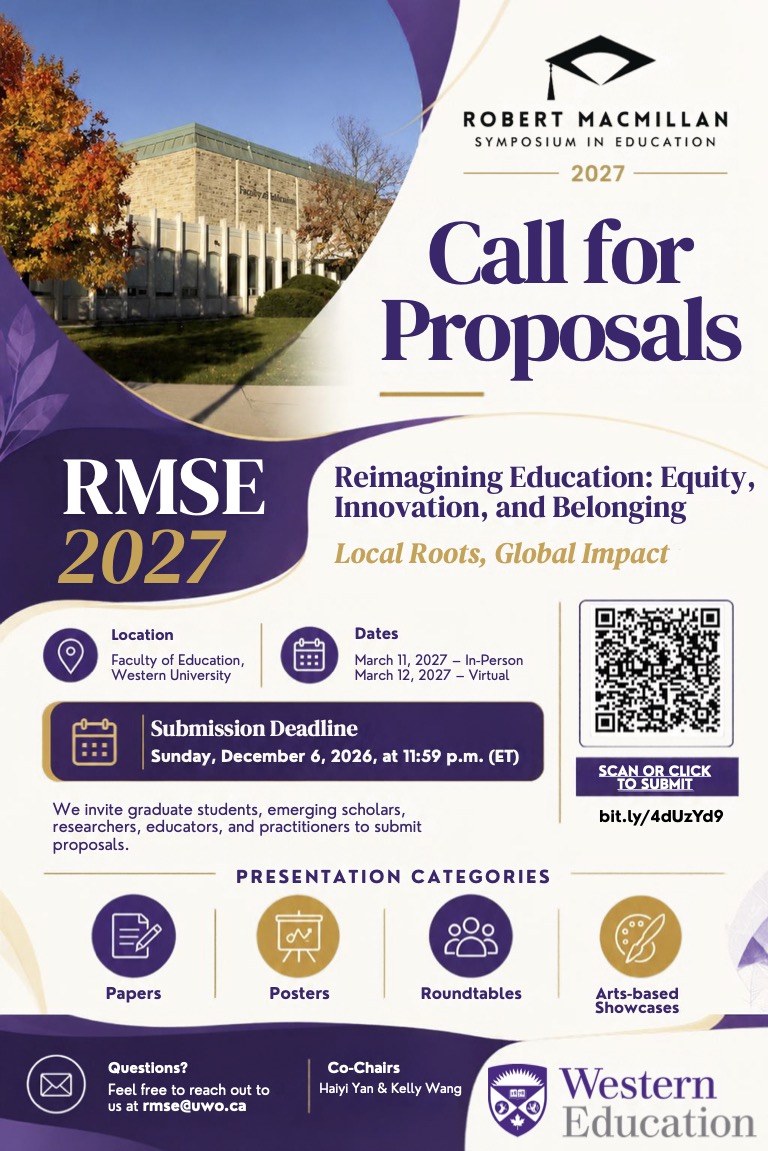
Robert Macmillan Symposium in Education (RMSE) 2027
Reimagining Education: Equity, Innovation, and Belonging
Local Roots, Global Impact
Conference Information
Date: March 11–12, 2027
Location: Faculty of Education, Western University
Address: 1137 Western Road, London, ON N6G 1G7
Proposal Deadline: December 6, 2026, at 11:59 p.m. (ET)
Submission Portal: https://forms.cloud.microsoft/r/HZhHkRT2V2
“Where the world has not been broken up into fragments by narrow domestic walls…
Where the clear stream of reason has not lost its way into the dreary desert sand of dead habit”
— Rabindranath Tagore রবীন্দ্রনাথ ঠাকুর FRAS, Gitanjali 35
The Robert Macmillan Symposium in Education (RMSE) is a student-led tradition at Western University that brings together graduate students and emerging scholars to share and engage with innovative education-related research. Established in 2010 and renamed in honour of Dr. Robert Macmillan following his passing in 2012, the symposium continues his vision of fostering connection, dialogue, and community across education and beyond.
RMSE 2027 welcomes proposals that engage critically and creatively with the conference theme, “Reimagining Education: Equity, Innovation, and Belonging,” and its subtheme, “Local Roots, Global Impact.” We encourage students and emerging scholars to consider not only what they present, but also how their work might foster dialogue, challenge established ways of knowing, and contribute to collective understandings of educational research and practice.
In keeping with the conference’s commitment to diverse forms of scholarly inquiry, RMSE 2027 invites submissions across four presentation categories: Papers, Posters, Roundtables, and Arts-based Showcases. These formats are intended to accommodate different stages of research development, methodological orientations, and modes of scholarly communication. We particularly welcome proposals that foreground diverse perspectives, interdisciplinary approaches, emerging research, and critical engagements with educational questions.
- Possible areas of inquiry include, but are not limited to:
- Curriculum, pedagogy, and educational theory
- Language, literacy, and multilingual education
- Equity, diversity, inclusion, and belonging
- Artificial intelligence, digital technologies, and education
- Teacher education and professional learning
- Indigenous, decolonial, and anti-colonial approaches to education
- Educational policy and governance
- International and comparative education
- Higher education and graduate education
- Educational experiences of marginalized and minoritized communities
- Community-engaged and participatory research
- Emerging methodological and theoretical approaches in education
These areas are intended as examples rather than an exhaustive list. Proposals that engage with educational questions beyond these areas are also welcome, particularly where they connect meaningfully with the conference theme and subtheme.
1. Papers
Paper presentations provide an opportunity for presenters to share empirical research, theoretical inquiries, methodological reflections, conceptual analyses, or works in progress that contribute to conversations in education and related fields. Papers may draw upon qualitative, quantitative, mixed-methods, theoretical, philosophical, historical, or other scholarly approaches.
We welcome both completed studies and research that is currently developing. A paper proposal should clearly articulate the research problem or question, relevant literature or conceptual framework, methodological approach where applicable, and the contribution or implications of the work. For works in progress, presenters are encouraged to identify the emerging insights, tensions, questions, or methodological considerations that their work brings forward (Apple, 2018; Fricker, 2007; Priestley, 2026; Smith, 2022).
Paper presentations are particularly appropriate for presenters who wish to develop a sustained scholarly argument and engage participants through a focused presentation followed by discussion.
Proposal length: 300–400 words, excluding title and references.
Paper proposals should include, as appropriate:
- The research problem, question, or purpose;
- Relevant literature and/or theoretical or conceptual framework;
- Methodological approach and research context;
- Key findings or anticipated findings, where applicable;
- Significance and contribution to educational research, theory, policy, and/or practice;
2. Posters
Poster presentations provide an engaging visual format for sharing research, scholarly ideas, and developing projects with the conference community. They may be based on completed studies, preliminary findings, pilot projects, dissertation or thesis research, conceptual explorations, methodological innovations, or works in progress. This format is well suited to projects at various stages of development and to research for which visual presentation can effectively communicate key ideas, processes, or findings.
Unlike a traditional paper presentation, a poster presentation emphasizes ongoing conversation rather than a formal oral presentation. Presenters are encouraged to view the poster as a distinct scholarly format that invites questions, fosters connections across areas of inquiry, and supports collaborative exploration of ideas. (MacIntosh-Murray, 2007; Faulkes, 2023; Freedman et al., 2025; Kiger et al., 2026).
A strong poster proposal should clearly describe the purpose, significance, and contribution of the work. Depending on the nature of the project, proposals may discuss research questions, theoretical or conceptual frameworks, methodological approaches, data visualizations, findings, implications, or other forms of visual representation that will be featured in the poster.
Poster presentations are particularly appropriate for researchers seeking to share developing ideas, receive perspectives from a diverse audience, broaden their professional networks, and participate in scholarly conversations in an accessible and interactive format.
Proposal length: 250–350 words, excluding title and references.
- Poster proposals should include, as appropriate:
- The purpose or central question of the project;
- Relevant theoretical or conceptual perspectives;
- Research context and methodology, where applicable;
- Key findings, emerging insights, or anticipated contributions;
- A brief indication of how the research will be represented visually;
3. Roundtables
Roundtable presentations provide a collaborative forum for examining educational questions, challenges, and emerging areas of inquiry. Rather than focusing on the presentation of individual research projects, roundtables are organized around a shared topic, problem, or theme that invites collective exploration and discussion.
This format is particularly suited to topics that do not lend themselves to straightforward answers or single perspectives. Roundtables may address emerging issues in education, explore unresolved debates, examine methodological or ethical challenges, consider implications for policy and practice, or identify future directions for research (Cannon et al., 2026; Henderson & Burford, 2020; King et al., 2023; Matusov & Pease-Alvarez, 2020).
A strong roundtable proposal should clearly articulate the central topic or guiding question, explain its significance, identify the perspectives that will be represented, and describe how discussion will be facilitated among presenters and participants.
oundtable presentations are especially appropriate for interdisciplinary initiatives, collaborative projects, research collectives, and communities of inquiry seeking to advance understanding through critical reflection, dialogue, and shared problem-solving.
Proposal length: 400–500 words, excluding title and references.
- Roundtable proposals should include:
- A clearly identified topic, issue, or question;
- The rationale and significance of the proposed discussion;
- Relevant literature, theoretical perspectives, or conceptual frameworks;
- A brief description of the perspectives or contributions that each participant will bring;
- The proposed structure and facilitation approach;
- Strategies for engaging conference participants in meaningful dialogue;
4. Arts-based Showcase
RMSE 2027 CALL FOR PROPOSALS | 4The Arts-based Showcase provides a space for researchers and emerging scholars to communicate educational experiences, research inquiries, and scholarly ideas through creative, artistic, embodied, and multimodal forms of expression. We welcome submissions that challenge conventional boundaries between research, scholarship, art, and creative practice.
Arts-based submissions may include, but are not limited to, visual art, photography, poetry, creative writing, storytelling, performance, theatre, music, digital media, film, installation,
participatory art, or other multimodal and creative forms. Proposals may present an artistic work itself, describe an arts-based research process, or use creative practice as a means of engaging with a research question or educational issue.
Arts-based research has been described as an approach that can expand the ways in which knowledge is generated, represented, and communicated, particularly by creating possibilities for forms of knowing that may not be fully captured through conventional academic discourse (Barone & Eisner, 2012; Leavy, 2020, 2025). We particularly encourage submissions that explore how creative and embodied forms of inquiry can illuminate lived experiences, identities, emotions, relationships, communities, and forms of knowledge that have historically been marginalized within traditional academic spaces (Alormele, 2025; Bagley & Castro-Salazar, 2012; McKinson, 2022).
Participatory and interactive approaches are welcome. Presenters may invite participants to engage directly with, contribute to, or respond to their creative work where appropriate. Such engagement may include collaborative making, discussion, movement, performance, reflection, or other forms of participation. Participation, however, is not mandatory; proposals may also involve forms of artistic presentation that are primarily observational, performative, or experiential.
Presenters who propose participatory or interactive activities are responsible for providing any specialized, consumable, or participant-specific materials required for their activities. Proposals should indicate any significant material, spatial, technological, or accessibility requirements so that the organizing committee can assess whether these can be accommodated within the conference setting.
Proposal length: 300–500 words, excluding title and references.
Arts-based Showcase proposals should include:
- A description of the proposed creative or arts-based work;
- The educational, scholarly, or research inquiry informing the work;
- The creative medium(s) or mode(s) of presentation;
- Relevant theoretical, conceptual, methodological, or artistic frameworks, where applicable;
- An explanation of how the creative work contributes to or communicates knowledge;
Review and Assessment Criteria
All submissions will be evaluated through a peer-review process conducted by members of the RMSE 2027 Review Committee. Reviewers will assess proposals according to the presentation format while recognizing that proposals may represent completed studies, works in progress, conceptual inquiries, methodological reflections, or creative scholarly practices.
Reviewers will consider the following criteria, as appropriate to the submission category:
- Alignment to the conference theme and/or subthem
- The proposal meaningfully connects with the conference theme and/or subthemethrough relevant or innovative perspectives on its core concepts.
- Clarity of purpose and focus
- The proposal clearly identifies its research question, purpose, central argument,inquiry, or creative intention.
- Scholarly and/or creative contribution
- The proposal demonstrates potential to contribute to educational research, theory,policy, practice, methodology, or creative knowledge-making.
- Conceptual, theoretical, or methodological coherence
- The proposal presents a clear and appropriate framework, approach, or rationalefor the work.
- Engagement and significance
- The proposed presentation is likely to stimulate discussion, reflection, collaboration, or learning among conference participants.
- Quality of communication
- The proposal is clearly written, well organized, and appropriate for the selectedpresentation format.
For Arts-based Showcase submissions, reviewers may additionally consider:
- The relationship between the creative form and the educational inquiry;
- The effectiveness of the proposed artistic or multimodal approach in communicating knowledge;
- Feasibility within the conference context.
For Roundtable submissions, reviewers may additionally consider:
- The diversity and complementarity of perspectives represented;
- The quality of the proposed participant engagement strategy;
- The extent to which the format supports meaningful dialogue and collaborative knowledge production.
RMSE 2027 values diverse forms of scholarship. Reviewers will not privilege any single methodological, theoretical, disciplinary, epistemological, or representational approach. Works in progress, exploratory studies, creative practices, and emerging research will be assessed according to their stated goals and stage of development.
Submission Policies
1. Number of Submissions
To encourage broad participation and provide opportunities for as many students and emerging scholars as possible, each individual may submit a maximum of two proposals as a primary presenter.
Participants may appear as a co-author, co-presenter, or collaborator on additional proposals. However, individuals should not submit substantially identical work in multiple presentation formats.
We encourage collaborative submissions and welcome proposals involving presenters from different institutions, disciplines, educational contexts, and stages of study.
2. Language(s) of Proposals
Proposals should be submitted in English to facilitate a consistent review process.
At the same time, RMSE recognizes and values the linguistic diversity of educationalcommunities. Where appropriate, presenters are encouraged to incorporate multilingualperspectives, terminology, quotations, data, or other linguistic resources into their proposals.
3. Language(s) of Presentation
Presentations will primarily be delivered in English. However, RMSE welcomes the thoughtful incorporation of other languages and multilingual practices where appropriate to the presentation, research context, artistic work, or participants involved.
Presenters who anticipate incorporating languages other than English are encouraged to indicate this during the submission process so that the organizing committee can consider accessibility and audience engagement needs.
Where possible, presenters should provide English-language summaries, slides, captions, or other forms of support when substantial portions of a presentation are delivered in another language.
4. Anonymity and Peer Review
All proposals will undergo peer review by members of the RMSE 2027 review committee.
To support a fair and equitable review process, proposals should be prepared for anonymous review. Please do not include your name, institutional affiliation, or other identifying information within the proposal text.
When referring to your previous research, avoid language that directly identifies yourself or your co-authors. For example, instead of writing:
In our previous study (Yan & Wang, 2025), we found…
consider writing:
Previous research has found…
Presenter names, affiliations, and contact information will be collected separately through the submission system and will not be shared with reviewers.
5. Multiple Presenters and Collaborative Submissions
RMSE welcomes collaborative proposals involving multiple presenters. All presenters should make a meaningful contribution to the proposed session and should be listed during the submission process.
For Roundtable Discussions, proposals should clearly identify the proposed participants and indicate the role each participant will play in the discussion.
For Arts-based Showcases, collaborative and interdisciplinary submissions are particularly encouraged where artistic practice, research, and community knowledge intersect.
References
Alormele, N. (2025). “I dream of an island”: Black joy, storytelling and the art of refusal.Creative methodologies and decolonial praxis in higher education. Frontiers in Sociology,10, Article 1537033. https://doi.org/10.3389/fsoc.2025.1537033
Apple, M. (2018). Ideology and curriculum (4th ed.). Routledge.
Bagley, C., & Castro-Salazar, R. (2012). Critical arts-based research in education: Performingundocumented historias. British Educational Research Journal, 38(2), 239–260.https://doi.org/10.1080/01411926.2010.538667
Barone, T., & Eisner, E. W. (2012). Arts based research. SAGE.
Cannon, S. E., Lave, R., & Tadaki, M. (2026). Unsettling academic conferences: Authority,reciprocity, and the ethics of place. Conservation Letters, 19(3).https://doi.org/10.1111/con4.70064
Faulkes, Z. (2023). The “wall of text” visual structure of academic conference posters. Frontiers in Communication, 8, Article 1063345. https://doi.org/10.3389/fcomm.2023.1063345
Freedman, D. E., Oh, J., & Feinstein, A. (2025). Fostering conversations at your academicposter: Creating space for comments and interaction. Neurology: Education, 4(2), Articlee200211. https://doi.org/10.1212/NE9.0000000000200211
Fricker, M. (2007). Epistemic injustice: Power and the ethics of knowing. Oxford University Press.
Henderson, E. F., & Burford, J. (2020). Thoughtful gatherings: gendering conferences as spaces of learning, knowledge production and community. Gender and Education, 32(1), 1–10. https://doi.org/10.1080/09540253.2019.1691718
Kiger, M., Burns, A., McGreevy, J., Halvorson, E. E., Li, S. T., Hart, R., & Nelson, A. (2026).Designing better research posters: A primer and recommendations. Journal of Hospital Medicine. https://doi.org/10.1002/jhm.70354
King, D., Griffin, M., & Bell, E. (2023). Inclusion and exclusion in management education and learning: A deliberative approach to conferences. Academy of Management Learning & Education. 22(1), 40–62. https://doi.org/10.5465/amle.2020.0089
Leavy, P. (2020). Method meets art: Arts-based research practice (3rd. ed.). The Guilford Press.
Leavy, P. (Ed.). (2025). Handbook of arts-based research (2nd ed.). The Guilford Press.
MacIntosh-Murray, A. (2007). Poster presentations as a genre in knowledge communication: A case study of forms, norms, and values. Science Communication, 28(3), 347–376. https://doi.org/10.1177/1075547006298251
Matusov, E., & Pease-Alvarez, L. (2020). Moving from collaboration to critical dialogue in action in education. Dialogic Pedagogy, 8. https://doi.org/10.5195/dpj.2020.292
McKinson, K. D. (2022). The margin speaks: On the radical possibilities of embodied knowledge as decolonial pedagogy. Cultural Anthropology, 37(3). https://doi.org/10.14506/ca37.3.03
Priestley, M. (2026). Curricular justice in a complex world. The Curriculum Journal, 37(1), 164–171. https://doi.org/10.1002/curj.345
Smith, L. T. (2022). Decolonizing methodologies: Research and Indigenous peoples (3rd. ed.). Bloomsbury Academic.
For questions regarding the Call for Proposals or RMSE 2027, please contact the RMSE 2027
Organizing Committee at rmse@uwo.ca .
RMSE 2027 Organizing Committee
Western University
London, Ontario, Canada